Wire Butt Welders by Sterco — Seamless Joints for Continuous Wire Processing
Every wire drawing line stops the moment a coil runs out — unless the end of one coil is already joined to the start of the next. A Sterco wire butt welder makes that joint in seconds, flat, strong and thin enough to pass through the next die without snapping or jamming the line.
Sterco supplies wire butt welding machines to wire drawing units, galvanizing plants, wire mesh and nail manufacturers, spring makers and cable armouring lines across India, built for the one job that cannot afford to fail mid-shift.
What Is a Wire Butt Welder?
A wire butt welder is a resistance welding machine that joins two wire ends together, end to end, by clamping them in aligned electrodes, passing heavy current through the contact point, and forging the softened ends together under axial pressure.
Unlike overlap or splice joints, a butt weld produces a joint that is essentially the same diameter as the parent wire once dressed and ground. That is exactly what a wire drawing die, capstan or spooler needs to see — nothing that catches, nothing that thickens the pass.
How Sterco Wire Butt Welders Work
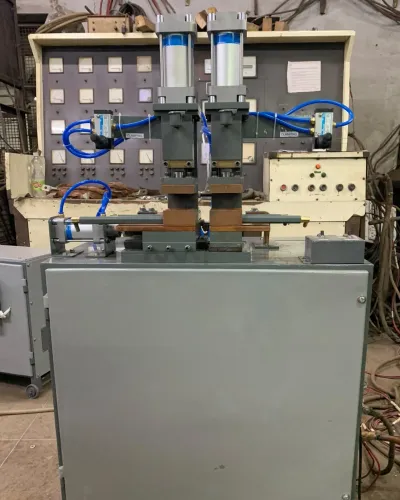
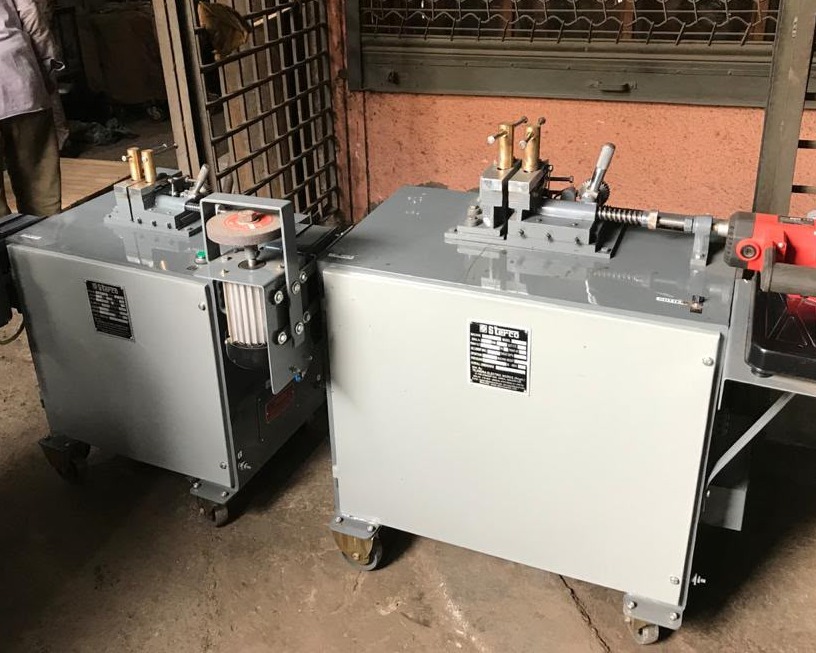
Clamp — The two wire ends are loaded into opposing jaw sets and clamped, aligned dead straight on the same centreline.
Squeeze — The jaws close the gap, bringing the wire ends into firm contact under set pressure.
Weld — Current flows through the contact point. Resistance at the interface heats the ends rapidly to forging temperature.
Upset/Forge — An axial forging stroke pushes the softened ends together, expelling oxides and impurities and forming a solid metallurgical bond, typically with a small upset bulge at the joint.
Release and dress — The welded wire is released; the upset bulge is ground or rolled flush so the joint runs cleanly through downstream dies and guides.
Sterco controllers allow current, weld time and forging pressure to be set and stored by wire gauge, so operators switch between wire sizes without re-tuning the machine by trial and error.
Sterco Product Range
Manual wire butt welders — For smaller gauges and lower-volume operations, with hand-operated clamping and forging.
Pneumatic wire butt welders — Air-operated clamping and forging stroke for consistent pressure and faster cycles, suited to continuous production lines.
Heavy-duty wire butt welders — Higher KVA ratings for thicker wire and wire rod, built for wire drawing lines running near-continuous shifts.
Inline butt welders for automatic lines — Integrated directly into wire drawing, galvanizing or annealing lines, triggered automatically when a coil end is detected.
Key Features
Robust cast or fabricated body engineered to hold electrode alignment precisely over years of forging cycles
Wire gauge range from fine wire up to heavy wire rod, depending on model and KVA rating
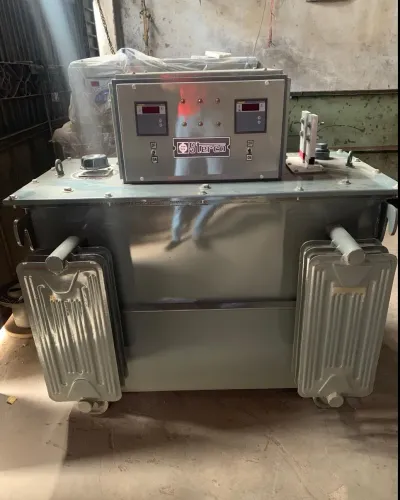
Precise current control via microprocessor or transformer tap regulation, matched to wire material and diameter
Adjustable forging pressure and stroke, independent of weld current, for control over joint quality
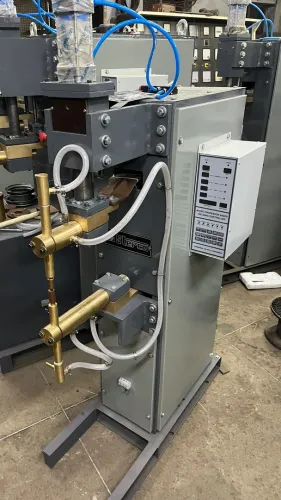
Water-cooled electrodes and transformer on higher-capacity models for sustained duty cycles
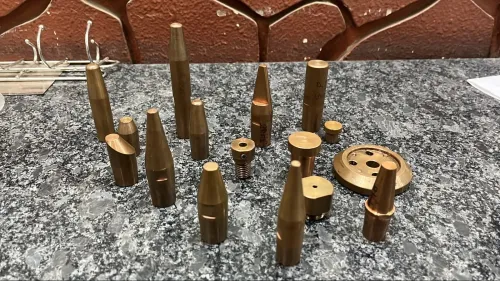
Quick-change jaw sets for fast changeover between wire gauges
Foot pedal or push-button cycle initiation, with interlocks for safe clamping
Compact footprint suited for direct mounting inline with drawing machines, spoolers or pay-off/take-up stands
Applications
Wire drawing — joining coil ends for uninterrupted drawing through successive dies
Wire galvanizing and coating lines — maintaining continuous wire feed through cleaning, coating and cooling sections
Wire mesh, weld mesh and fencing manufacture — joining feedstock wire for uninterrupted mesh weaving
Nail and fastener manufacturing — continuous wire feed into heading and pointing machines
Spring manufacturing — joining wire stock for coiling operations
Cable armouring and rope wire — joining strand wire for armouring and stranding lines
Materials handled include mild steel wire, high carbon steel wire, stainless steel wire and, with appropriate parameter settings, selected non-ferrous wire.
Why Choose Sterco
Built for the gauge you actually run. Tell us your wire diameter, material and line speed, and we will size the electrode force, current and forging stroke accordingly rather than offering a generic unit.
Joint quality that survives the next die. Our machines are set up and trial-welded on your wire specification before dispatch, so the weld you receive is the weld you will get on your floor.
Custom integration. Inline mounting, automatic triggering from line sensors, and matching to existing drawing or galvanizing equipment — handled as part of the supply, not an afterthought.
In-house manufacturing and service. Electrodes, jaws and control panels built under one roof, with nationwide installation, training and spares support.
Frequently Asked Questions
What is the difference between a wire butt welder and a spot welder?
A spot welder joins two overlapping sheets or components at a localised point using pointed electrodes. A wire butt welder joins two wire ends end-to-end along the same axis, using clamping jaws and a forging stroke rather than overlapping the material. The two machines serve entirely different joint geometries.
How strong is a wire butt weld compared to the parent wire?
A correctly set butt weld, properly dressed, generally reaches close to the strength of the parent wire and passes through dies and rollers without issue. Strength depends heavily on correct current, forging pressure and finishing — undersized current or poor dressing are the usual causes of a weak joint.
Can a wire butt welder handle different wire gauges on the same machine?
Yes, within the machine's rated range. Sterco controllers allow weld parameters to be stored and recalled by gauge, and jaw sets are changed to match the wire diameter, so one machine typically covers a working range of sizes rather than a single fixed gauge.
Does the welded joint need finishing after welding?
Almost always. The forging stroke creates a small upset bulge at the joint, which is ground, rolled or filed flush so the wire passes smoothly through dies, guides and take-up equipment without snagging.
What materials can be joined on a Sterco wire butt welder?
Mild steel and high carbon steel wire are the most common. Stainless steel wire welds well with adjusted parameters. Certain non-ferrous wires can also be joined, though results depend on the specific alloy — share your material specification for a definite recommendation.
Can the machine be integrated into an existing wire drawing line?
Yes. Sterco supplies inline units designed to mount directly on drawing machines, galvanizing lines or spoolers, with automatic cycle triggering when a coil end reaches the welder. Retrofitting to existing lines is common and handled case by case.
How fast is the weld cycle?
Cycle time depends on wire gauge and material but is typically a matter of seconds from clamping to release, since the line is otherwise stopped waiting for the joint. Pneumatic and inline models are built to minimise this downtime.
What is the price of a wire butt welder in India?
Price depends on wire gauge range, KVA rating, manual versus pneumatic operation, and whether the unit is standalone or integrated into an automatic line. Share your wire specification and line details with Sterco for an accurate quotation.
What maintenance does a wire butt welder need?
Routine care includes checking jaw and electrode contact surfaces for wear, verifying clamping and forging pressure, keeping cooling water circuits clean on water-cooled models, and periodically test-welding a sample to confirm parameters remain accurate.
Do I need special training to operate this machine?
Basic operation is straightforward once parameters are set for a given wire gauge. Sterco provides operator training at installation, covering safe clamping procedure, parameter selection by gauge, and dressing the finished joint.
Get a Quote
Send your wire diameter, material grade and line speed, and Sterco will recommend the right welder configuration — standalone or inline — for your process.
Keywords